


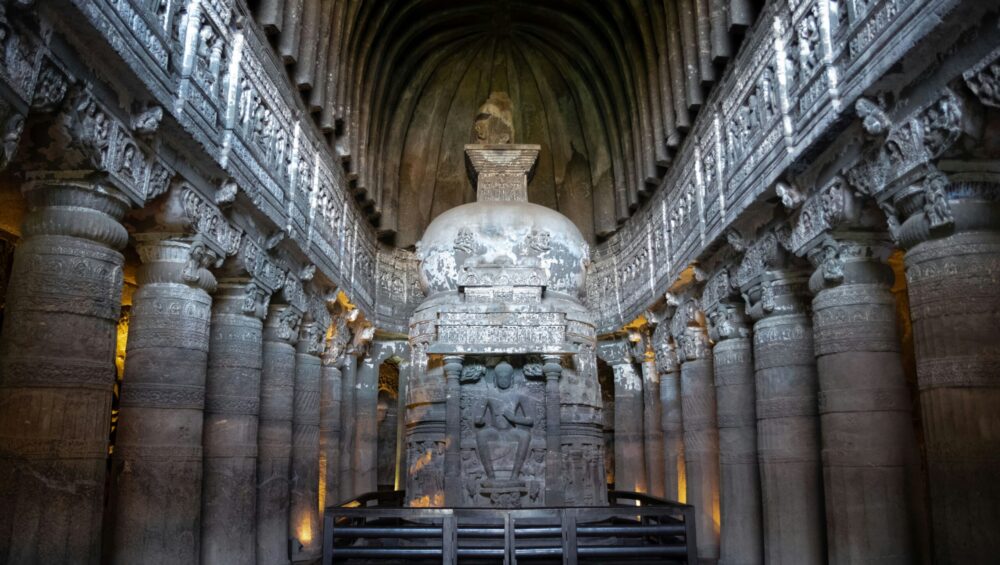
Some places make you admire skill.
Ajanta and Ellora make you question how far human devotion and imagination can go.
Carved directly into basalt rock in the Deccan plateau, these cave complexes are not ruins of fallen cities or abandoned temples. They are deliberate acts of patience — created over centuries by artists, monks, and craftsmen who believed that faith deserved permanence.
To visit Ajanta and Ellora is to walk through silence shaped by hands that worked without haste, knowing their work would outlast them.
You May Like to Read – UNESCO World Heritage Sites in India Worth Visiting
Ajanta Caves: When Walls Learned to Tell Stories
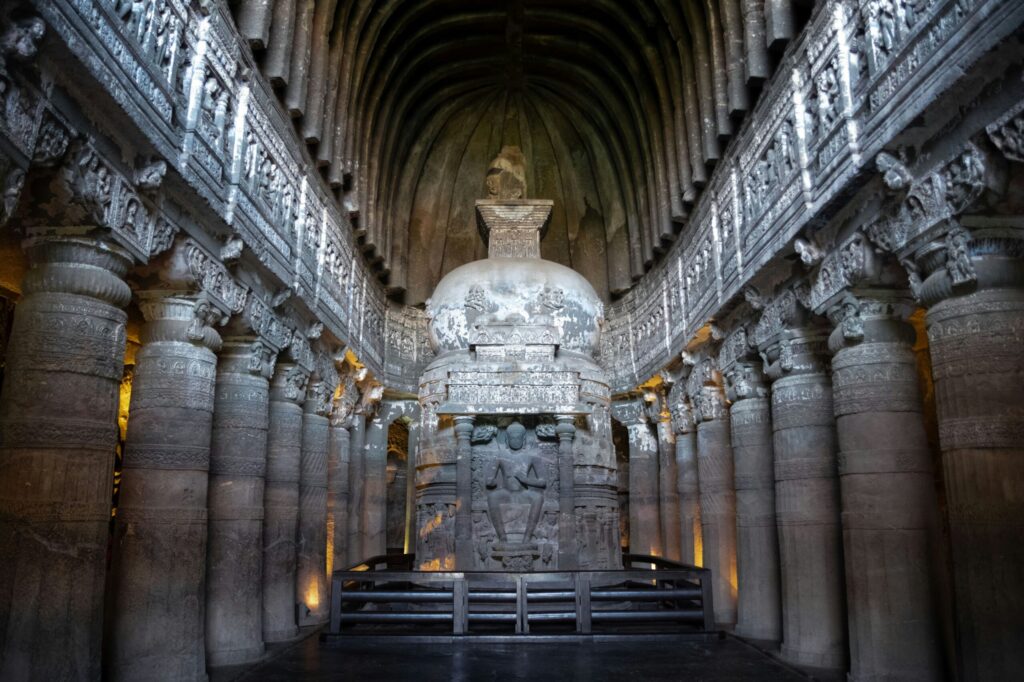
Ajanta feels inward, almost meditative. Hidden within a horseshoe-shaped gorge along the Waghora River, the caves reveal themselves slowly as you walk along the curved pathway. Created between the 2nd century BCE and the 6th century CE, Ajanta’s caves were built as Buddhist monasteries and prayer halls, meant for monks who lived, studied, and meditated here during the monsoon months.
What makes Ajanta extraordinary are its paintings. These murals do not decorate the walls — they inhabit them. Scenes from the Jataka tales, royal courts, forests, and everyday life unfold with softness, emotion, and depth rarely seen even today. Faces express compassion, curiosity, longing. Colours, made from natural minerals, still breathe after centuries. Ajanta does not overwhelm you; it draws you into stillness.
You May Like to Read – Konark Temple: Where Stone, Science, and Devotion Rise With the Sun
Ajanta’s Chaityas and Viharas: Life Shaped Around Faith
The caves of Ajanta are carefully divided into chaityas (prayer halls) and viharas (monastic residences). The chaityas, with their arched roofs and central stupas, invite quiet circumambulation and reflection. The viharas tell a more personal story — cells for monks, shared courtyards, carved pillars that balanced simplicity with dignity.
Walking through these spaces, it becomes clear that Ajanta was never meant for crowds. It was designed for thought, study, and inner discipline. Even today, voices drop naturally as visitors move through the caves.
Ellora Caves: Many Faiths, One Landscape
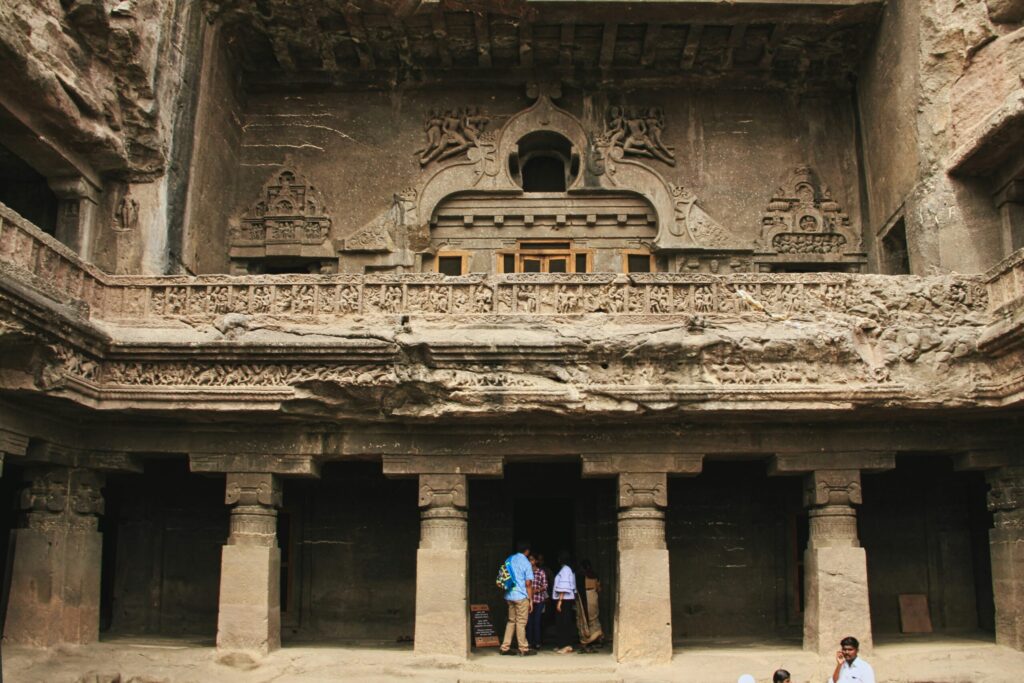
Ellora is outward, expansive, and confident. Unlike Ajanta’s hidden seclusion, Ellora stands openly on a plateau, its caves aligned along a single cliff face. Built between the 6th and 10th centuries, Ellora represents something rare and deeply Indian — the peaceful coexistence of Buddhism, Hinduism, and Jainism within one complex.
As you move from cave to cave, you don’t feel transition through conflict, but through philosophy. Each tradition expresses itself fully, without diminishing the others. Ellora is not just a heritage site; it is a lesson in cultural maturity.
You May Like to Read – Tamil Nadu Temple Trail
Kailasa Temple: A Mountain Carved Downward
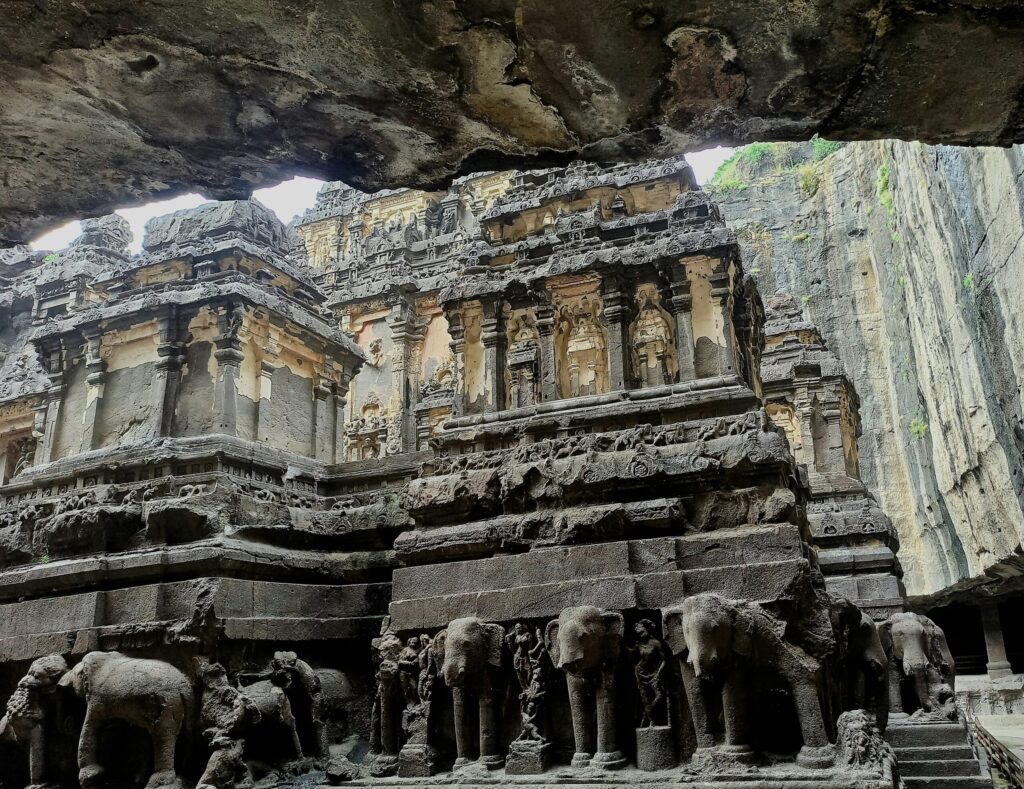
The Kailasa Temple at Ellora is not simply impressive — it is almost impossible to comprehend. Carved entirely from a single rock, top to bottom, this massive structure dedicated to Lord Shiva was not assembled, but excavated. Craftsmen removed an estimated 400,000 tons of rock to reveal a fully formed temple complex, complete with courtyards, shrines, sculptures, and towering pillars.
Standing before Kailasa, the mind struggles to accept that this was achieved without modern tools. But beyond technique, what stays with you is intention. This was not built to display power alone — it was built as devotion made permanent.
You May Like to Read – Mahabodhi Temple: Where Silence Became Awakening
Ellora’s Buddhist and Jain Caves
While Kailasa dominates attention, Ellora’s Buddhist and Jain caves offer something equally valuable — restraint. The Buddhist caves focus on monastic discipline and teaching spaces, while the Jain caves, especially those in the northern section, showcase refined detailing, symmetry, and philosophical clarity.
The Jain caves, in particular, feel serene and precise. Their carvings are delicate, controlled, and introspective — reflecting Jain values of non-violence and detachment. These caves reward patience and observation rather than spectacle.
You May Like to Read – Gujarat Heritage Trail: UNESCO Sites, Fort Cities & Timeless Culture
How Ajanta and Ellora Complement Each Other
Ajanta and Ellora are often visited together, but they are not similar experiences. Ajanta turns you inward. Ellora opens outward. Ajanta speaks through colour and emotion; Ellora through scale and structure. Together, they form a complete expression of Indian thought; where introspection and expression are not opposites, but partners.
This balance is what makes them a UNESCO World Heritage Site of global importance.
You May Like to Read – Hampi: Walking Through the Silence of an Empire
Best Time to Visit Ajanta & Ellora
The ideal time to explore Ajanta and Ellora is between October and March, when the weather is comfortable for walking and observation. Summers can be extremely hot, and monsoons may affect access to Ajanta due to its gorge location.
Early mornings are best for both sites; lighting is softer, crowds are thinner, and the experience feels more personal.
Reaching Ajanta and Ellora
Aurangabad serves as the gateway city for both cave complexes, with good air, rail, and road connectivity. Ellora is closer to the city and easier to reach, while Ajanta requires a longer drive through scenic countryside. Most travellers plan a two- to three-day itinerary to experience both without rushing.
Ajanta and Ellora are not reminders of what we lost.
They are reminders of what we once understood.
That art could educate.
That faith could coexist.
That patience could create permanence.
In a fast-moving world, these caves stand still; not resisting time, but transcending it.
Explore Ajanta & Ellora With World Tours
Sites like Ajanta and Ellora deserve thoughtful pacing and cultural context. World Tours curates heritage journeys that allow travellers to experience these caves without fatigue, confusion, or rush combining comfort with deeper understanding.
If you wish to explore India’s heritage at its most profound, Ajanta and Ellora are essential and World Tours is here to plan that journey with care.