


Mumbai is known for speed. Trains, traffic, conversations, ambitions; everything moves fast.
And yet, just an hour away from this constant motion, across the waters of the Arabian Sea, lies a place that has been still for over a thousand years. The Elephanta Caves sit quietly on an island in Mumbai’s harbour, reminding visitors that long before the city rose into a financial powerhouse, this coastline was already shaping spiritual and artistic expression.
Visiting Elephanta feels less like leaving Mumbai and more like stepping into a pause that the city itself seems to protect.
The Journey Itself Sets the Tone
The experience of Elephanta begins not at the caves, but on the ferry ride from the Gateway of India. As the boat pulls away from the shore, the skyline slowly recedes, replaced by open water and sea breeze. The noise of the city fades, conversations soften, and the rhythm changes.
By the time the island appears on the horizon, covered in greenery and rising gently from the sea, you’re already in a different frame of mind. Heritage here is not announced; it reveals itself gradually.
An Island Shaped by Faith and Time
Elephanta Island, known locally as Gharapuri, was once an important centre of Shaivism. The caves were carved between the 5th and 8th centuries CE, directly into basalt rock, by craftsmen whose names we may never know but whose skill remains unmistakable.
Unlike freestanding temples, rock-cut caves demand patience and precision. Every mistake is permanent. The creators of Elephanta worked with the rock, not against it, shaping spaces meant for meditation, ritual, and philosophical contemplation.
What remains today is not a ruin, but a deliberate expression of belief.
The Great Cave: Entering the World of Shiva
The main attraction at Elephanta is the Great Cave (Cave 1), and stepping inside it feels like crossing a threshold. The air cools instantly, light dims, and sound changes. Massive stone pillars rise from the floor, guiding your eyes inward toward the sculpted walls.
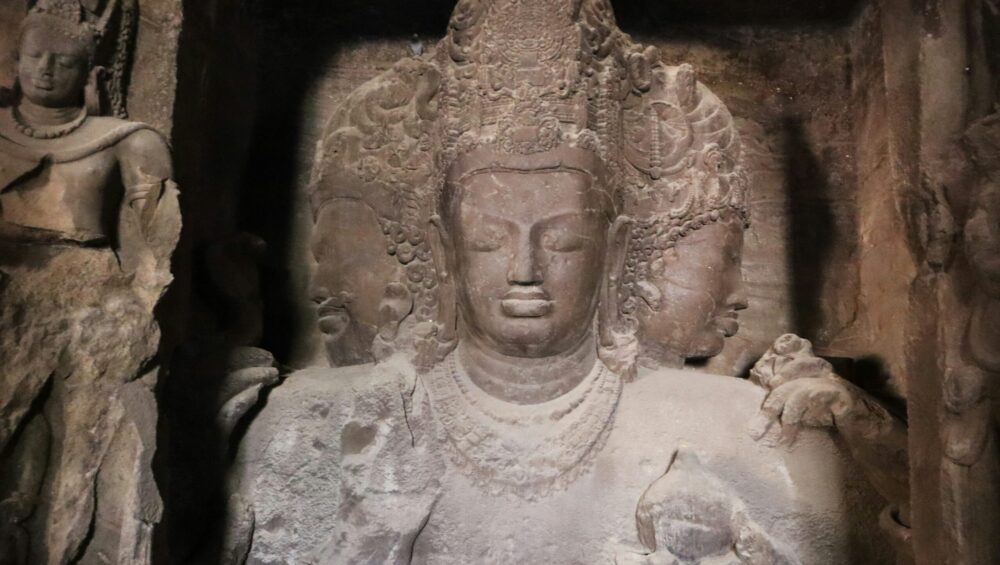
At the heart of this cave stands one of India’s most powerful sculptures the Trimurti. This three-faced representation of Lord Shiva captures creation, preservation, and destruction in a single form. Calm, fierce, and introspective expressions coexist without contradiction.
You don’t need to understand iconography to feel its impact. The scale, symmetry, and stillness speak directly.
Stories Carved in Stone
Surrounding the central shrine are panels depicting various forms of Shiva as yogi, warrior, householder, and cosmic force. Each sculpture tells a story, but none shout for attention. The figures are balanced, restrained, and deeply intentional.
What’s striking is the absence of excess. These carvings were not meant to impress visitors or rulers; they were created for those who understood their symbolism. That quiet confidence is what gives Elephanta its dignity.
Standing here, you realise that ancient Indian art often trusted the viewer it didn’t overexplain.
Beyond the Main Cave: Layers of Meaning
While the Great Cave draws most visitors, the other caves on the island add depth to the experience. Some are unfinished, some simpler, but all contribute to understanding Elephanta as a working religious complex rather than a single masterpiece.
Walking between caves, with forested paths and glimpses of the sea, creates a rhythm; stone, silence, light, nature. It’s this combination that makes Elephanta feel balanced rather than heavy.
Why Elephanta Feels Different From Other Heritage Sites
Elephanta does not overwhelm you with scale like Hampi, or with detail like Khajuraho. Its power lies in contrast ancient stillness against a modern city, permanence against constant change.
It also feels accessible. You don’t need long leaves, extensive planning, or deep historical knowledge to appreciate Elephanta. And yet, the more time you give it, the more it offers.
For many travellers, this becomes their first meaningful heritage experience and often, the one that sparks interest in exploring more.
Best Time to Visit Elephanta Caves
The most comfortable time to visit Elephanta is between November and February, when Mumbai’s weather is pleasant and ferry rides are smoother. Monsoon months often see ferry cancellations, while summer heat can make the climb uncomfortable.
Early morning visits are ideal, allowing you to explore the caves before crowds build up and light becomes harsh.
Reaching Elephanta and Planning the Visit
Ferries to Elephanta depart regularly from the Gateway of India. The crossing takes about an hour. Once on the island, a short walk and toy train ride lead to the caves, followed by a climb up stone steps.
Though the visit can be completed in half a day, many travellers prefer not to rush taking time to sit inside the cave, observe details, and absorb the atmosphere.
Elephanta does not ask you to admire it endlessly.
It asks you to slow down.
It reminds you that Indian heritage was often inward-looking built for reflection rather than display. And that even beside one of the world’s busiest cities, silence can still survive.
Explore Elephanta Caves With World Tours
World Tours plans Elephanta experiences that balance timing, comfort, and context ensuring the visit feels unhurried and meaningful.
If you’re looking to discover a quieter side of Mumbai’s history, Elephanta Caves are waiting and World Tours is ready to plan the journey.