


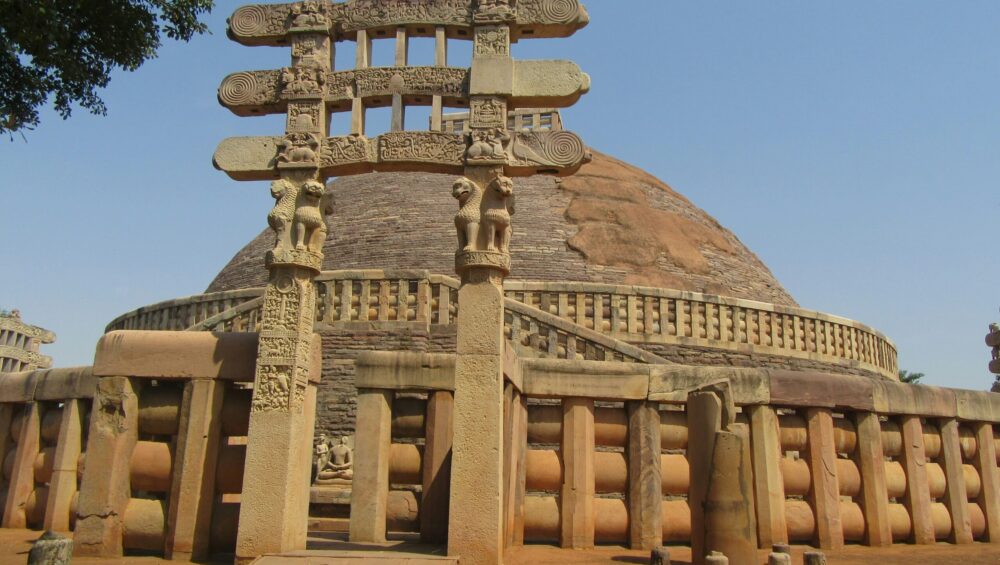
Some places don’t impress you immediately. They don’t rise dramatically against the sky or overwhelm you with ornamentation. Instead, they ask for patience.
Sanchi is one such place.
Set atop a quiet hill in Madhya Pradesh, the Sanchi Stupa stands not as a spectacle, but as a presence calm, complete, and deeply intentional. Long before grand temples and elaborate rituals shaped Indian religious architecture, Sanchi offered something simpler and far more enduring: a space for reflection.
To visit Sanchi is not to “see” history. It is to sit with it.
A Monument Born from an Idea, Not an Idol
The Great Stupa at Sanchi was commissioned in the 3rd century BCE by Emperor Ashoka, making it one of the oldest surviving stone structures in India. What’s remarkable is not just its age, but its philosophy.
Unlike later Buddhist sites, Sanchi does not contain an image of the Buddha. Instead, the stupa itself becomes the symbol representing enlightenment, impermanence, and the path to liberation. The dome shelters relics, but more importantly, it shelters an idea: that truth does not always need form.
This absence is not emptiness. It is deliberate restraint.
Walking the Circle of Time
The act of visiting Sanchi is designed to be meditative. The circular path around the stupa invites pradakshina a slow, clockwise walk that mirrors the Buddhist approach to mindfulness.
As you walk, the world seems to quiet down. Conversations fade. Footsteps soften. The structure doesn’t ask you to hurry or look harder; it asks you to stay.
This is architecture that slows the body so the mind can follow.
The Toranas – Stories Without Words
Four intricately carved gateways, known as toranas, mark the cardinal directions around the stupa. These gateways are among the finest examples of early Indian stone carving, yet they don’t depict gods or grand scenes of conquest.
Instead, they tell stories of everyday devotion — previous lives of the Buddha, symbols like footprints and trees, animals, villagers, and monks. The carvings are narrative, not ornamental.
What’s extraordinary is their accessibility. You don’t need scholarly knowledge to engage with them. The stories are human, familiar, and timeless.
A Living Monastic Landscape
Sanchi is not just one monument; it is an entire monastic complex. Scattered across the hill are the remains of monasteries, smaller stupas, assembly halls, and meditation spaces.
These structures speak of a time when Sanchi was a thriving centre of learning and spiritual exchange. Monks lived here, debated here, studied here — not in isolation, but in dialogue with the world.
Walking through the ruins, you begin to understand Sanchi not as a relic, but as a once-living community.
Why Sanchi Feels Different from Bodh Gaya
While Bodh Gaya marks a moment — the Buddha’s enlightenment — Sanchi represents a movement. It shows how Buddhist thought travelled, adapted, and rooted itself in collective practice.
Sanchi is quieter, less ceremonial, and far less crowded. That’s precisely its strength. For travellers seeking depth over display, Sanchi offers something rare: uninterrupted space to think.
Best Time to Visit Sanchi
The most pleasant time to visit Sanchi is between October and February, when the weather is cool and the surrounding landscape is green. Early mornings are especially peaceful, allowing visitors to experience the site in near silence.
Summer months can be harsh, and afternoons tend to feel exposed due to the open hilltop setting.
Reaching Sanchi and Planning the Visit
Sanchi is easily accessible from Bhopal, which has good rail and air connectivity. The short drive from the city feels like a gradual transition from urban bustle to rural calm. The site itself can be explored in half a day, but many travelers prefer to linger — sitting near the stupa, observing light and shadow, and absorbing the stillness. A visit to the nearby Sanchi Museum adds valuable context, helping connect symbolism with historical understanding.
Sanchi doesn’t give you photographs that beg for attention.
It gives you something quieter — a sense of balance.
In a country known for visual richness, Sanchi reminds us that simplicity can be powerful, and restraint can last longer than grandeur.
You don’t leave Sanchi exhilarated.
You leave grounded.
Plan Your Buddhist Heritage Journey with World Tours
Sanchi pairs beautifully with other Buddhist UNESCO sites such as Bodh Gaya and Ajanta, forming a thoughtful cultural circuit across central India. World Tours curates heritage journeys that allow time for understanding, not just sightseeing.
If you’re seeking a travel experience rooted in calm, philosophy, and timeless design, Sanchi Stupa deserves a place on your journey. Let World Tours plan it with care.